1. Origins: Eliza, the First “Therapist” of the 20th Century
In the 1960s, at MIT, Professor Joseph Weizenbaum developed Eliza, considered the first chatbot in history. This program simulated a Rogerian therapist. Its technique was based on pattern matching and phrase substitution. However, it merely returned questions or reworded statements with no real comprehension. Despite its simplicity, Eliza achieved unexpected results: many users believed it truly understood them. This phenomenon was later named the “Eliza Effect” (L.I.A., 2024a).
Eliza proved that a linguistic trick was enough to create the illusion of intelligence. This marked a key moment in AI history. While it didn’t showcase genuine understanding, it sparked ethical and philosophical debates—especially due to the emotional reactions it provoked (Tarnoff, 2023).
Imaginative depiction of Eliza providing therapy to a person
2. When Chatbots Began to Remember
2.1 Parry, the Paranoid Schizophrenic Chatbot
After Eliza, the 1970s brought chatbots like Parry. Parry simulated paranoid patterns. These bots had basic memory and context recognition, albeit rudimentary. They also incorporated more complex responses based on previous interactions. Parry, in particular, featured:
Memory (maintaining an internal state — its paranoid personality).
Rudimentary context recognition (sensitive topic activation, emotional state adjustment based on user interaction).
Complex responses based on previous inputs (tailored replies that reflected its paranoid beliefs and emotional shifts) (L.I.A., 2024b).
Interestingly, even psychiatrists couldn’t distinguish Parry from a real human patient. In fact, it could be argued that Parry was the first chatbot to pass a mini version of the Turing Test. Another fun fact: in 1972, Parry participated in a therapy session with Eliza (Khullar, 2023). A true digital celebrity meet-up.
2.2 Jabberwacky, the Fun Chatbot
In the 1990s, programs like Jabberwacky aimed for less rigid interactions with early learning capabilities. Though still rudimentary compared to today’s models, they were a clear step forward from rule-based systems. Jabberwacky’s standout improvement was its learning model—it didn’t need pre-programmed responses; instead, it learned from conversations with humans (Fryer, 2006; L.I.A., 2024a).
Jabberwacky still used patterns like Eliza but no longer depended on fixed responses. It also used working memory, which allowed it to respond immediately—even without full understanding. For example, if a user said, “I feel happy today,” it might reply, “What makes you happy?” This ability to reference previous messages enabled a more natural, human-like flow of conversation. Unlike earlier systems that treated each sentence in isolation, Jabberwacky introduced continuity (Vadrevu, 2018).
A curious fact about Jabberwacky is that some sources cite its creation date as 1988 or 1997. Both are accurate: the project began in 1988 and was publicly released in 1997 (Wikipedia Eng., 2025). Its creator, programmer Rollo Carpenter, designed it with one goal: to be fun (Arya, 2019).
Imaginative depiction of Jabberwacky chatting with a person
3. A Paradigm Shift: The Rise of GPT Models
The real breakthrough came in 2018 with the release of the first GPT‑1 model. This generative pre-trained model used transformers and vast amounts of data to predict the next word in a sentence (Marr, 2023).
This was followed by GPT‑2 (2019) and GPT‑3 (2020), both capable of generating coherent, varied paragraphs. In November 2022, OpenAI launched ChatGPT, based on GPT‑3.5, as a public chatbot. It could carry conversations, answer questions, and reflect human values (Iffort, 2023; Roumeliotis & Tselikas, 2023).
Imaginative depiction of GPT summarizing a book
4. ChatGPT: A Multimodal Conversational Platform
GPT‑4 launched in March 2023. Among its benefits were image understanding and advanced reasoning. Almost a year later, in May 2024, GPT‑4o was released. The “o” stands for omni. This model combines text, voice, image, and audio. It offers a smooth, multimodal experience through ChatGPT (Iffort, 2023).
Recently, OpenAI introduced autonomous agents based on ChatGPT. These agents can connect with visual browsers, terminals, APIs, and other tools. They can also perform complex tasks—all from a conversational interface (Martín Barbero, 2025).
Imaginative depiction of ChatGPT helping a young person with homework
5. Key Differences and Impact
Each historical chatbot has unique features that made them pioneering models. Older chatbots used patterns and scripts, while modern ones rely on neural networks and transformers.
Feature
Eliza / Scripts
GPT (ChatGPT)
Technology Base
Patterns and scripts
Neural networks and transformer models
Memory
Immediate context only
Wide context windows
Output Modality
Fixed text
Text, voice, images, audio
Interactivity
Very limited
Conversational, contextual, multimodal
Scalability
Limited
Broad, with multiple applications
Comparison table of chatbot features
6. What Comes After ChatGPT?
GPT‑5 is expected in 2025, aiming to unify models, tools, and capabilities into one “unified AI” (Disotto, 2025). Meanwhile, competitors like Google’s Gemini or Inflection AI’s Pi are also on the rise. Their releases were delayed for various reasons but are now gaining ground (Okemwa, 2025; Pinzón, 2023).
At the same time, there’s renewed interest in therapy-focused chatbots, like Woebot, which combine AI and psychology (Khullar, 2023).
Imaginative depiction of competition between chatbots
7. Conclusion
The history of chatbots is the history of humanity’s longing to be understood by machines. This desire has slowly taken shape, as seen in the advanced capabilities of the latest ChatGPT models.
Since their beginnings, chatbots have stirred controversy—especially regarding emotional interactions, a core trait of human nature. This issue was made evident by the Eliza Effect, where people believed they were speaking with a real person, even though Eliza only repeated preset phrases without true understanding.
Despite these early limitations—and perhaps because of them—chatbots have continued to evolve. Today, they support daily tasks, enhance productivity, and even participate in creative processes.
It’s up to us to better understand this technology. Only then can we use it effectively as a tool for support, companionship, or collaboration. And we must always remember that we come from different natures: one biological, the other artificial. These differences shape radically distinct experiences that limit full empathy—though it may appear otherwise. Yet this also happens among humans, causing similar challenges when it comes to collaboration, support, or love. In essence, whenever interaction takes place.
Imaginative depiction of communication between human and machine
Explore the history of conversational AI and spread the word!
1. The milestone that changed the relationship between humans and machines
Artificial intelligence has revolutionized the way we see the world. In fact, machine intelligence initially seemed like something out of science fiction. However, a key milestone occurred when an IBM supercomputer defeated the world chess champion—when Deep Blue beat Garry Kasparov (Bermejo, 2022).
It’s worth noting that this victory marked the first time a machine defeated a grandmaster under official conditions (IBM Corporation, 2023).
So, let’s take a look back at this legendary episode—from its origins to its impact on the evolution of AI.
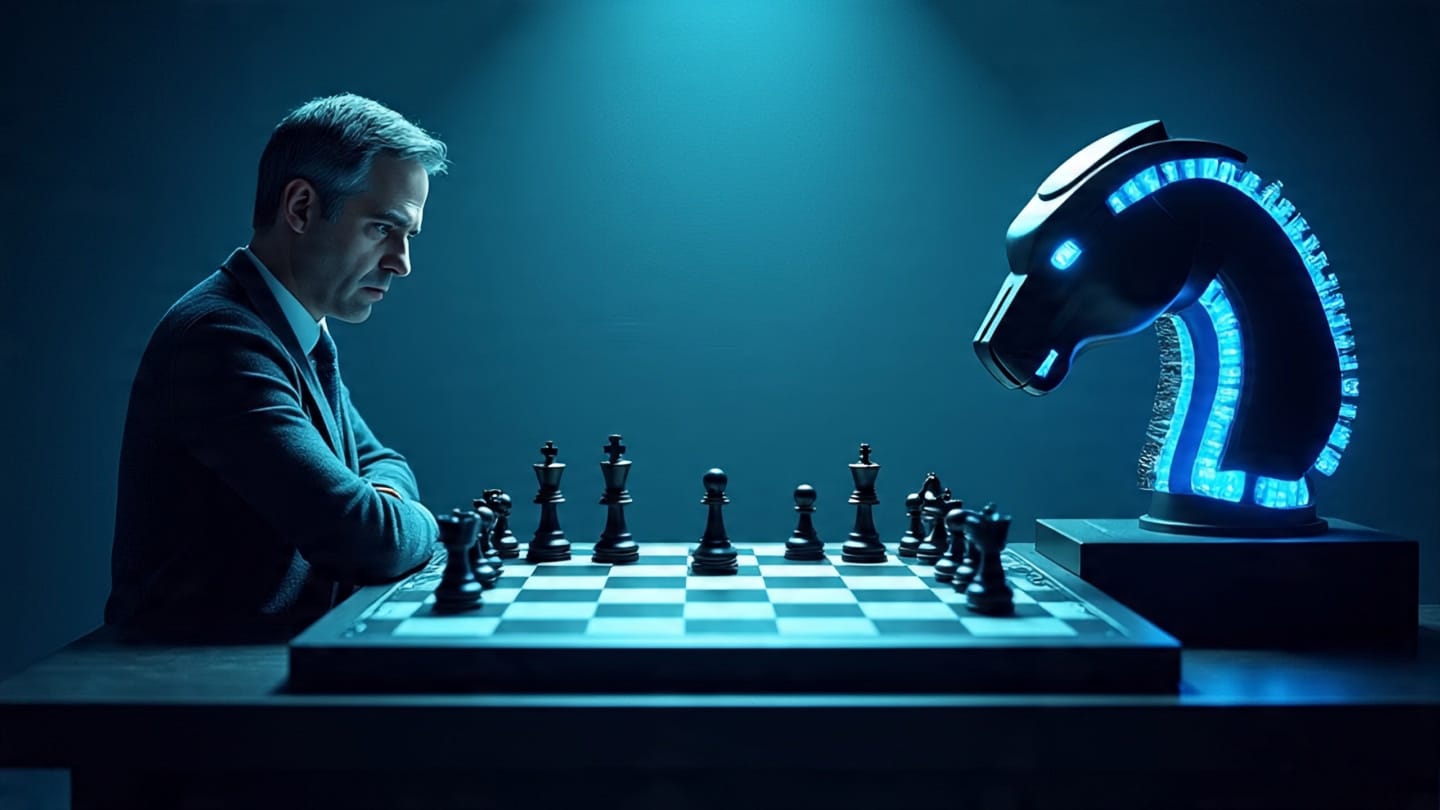
Imaginative representation of the encounter between Kasparov and Deep Blue
2. Origins of Deep Blue and the First Chess Programs
The story of Deep Blue began decades before the famous 1997 match. Chess had long been considered an ideal test for measuring machine “intelligence.” Moreover, in 1956, the Dartmouth Conference took place, where scientists like John McCarthy and Marvin Minsky formally established the field of artificial intelligence (Wikipedia Esp., 2025).
However, it wasn’t until the 1980s that the idea of chess-playing machines gained real momentum. For instance, the ChipTest program, launched in 1985 at Carnegie Mellon University, competed in two major computer chess tournaments: ACM 1986 and ACM 1987, winning the latter with a perfect score (CPW, 2020).
Shortly afterward, Deep Thought was developed (Wikipedia Eng., 2024). In 1989, Kasparov—already the world champion—defeated it with ease. That humbling loss pushed IBM to acquire the project and build an even more powerful machine. Thus was born the famous Deep Blue (Bermejo, 2022).
Imaginative representation of chess inside the computer’s ‘mind’ – Photo por PIRO4D en Pixabay –
3. The First Match Against Kasparov in 1996
The first official match against Kasparov took place on February 10, 1996, in Philadelphia (Blum, 2010). That day, Deep Blue arrived at the board equipped with cutting-edge technology. In fact, it was capable of calculating around one hundred million positions per second (Bermejo, 2022).
In the first game, the supercomputer won. This made it the first machine to defeat a reigning world champion under standard time controls (Schulz, 2021). The event was historic. However, Kasparov quickly recovered. After that initial scare, he went on to win three games and draw two. He secured the match with a final score of 4–2 (Fernández Candial, 2021).
Although Deep Blue lost that encounter, it had already proven its potential. More importantly, it had made history by beating the champion in a classical game (Schulz, 2021).
Imaginative depiction of Kasparov celebrating his victory
4. The 1997 Rematch and the Historic Victory
IBM didn’t give up and upgraded Deep Blue for the 1997 rematch in New York. The new machine (sometimes referred to as “Deeper Blue”) had even more memory and computing power.
In the match, Kasparov won the first game, but Deep Blue took the second (IBM Corporation, 2023). The next three games ended in draws. Then came the sixth and final game. In it, Deep Blue sacrificed pieces with precision, placing Kasparov in a critical position (Gupta, 2023). After only 19 moves (just about an hour of play), the Russian champion made a crucial mistake and resigned (García, 1997).
It was the first time in his career that Kasparov had ever abandoned a game (Gupta, 2023). Undoubtedly, a tough day in his professional journey.
Deep Blue, meanwhile, won the match with a final score of 3.5–2.5 (IBM Corporation, 2023). In other words, IBM’s supercomputer had defeated a grandmaster at his own game.
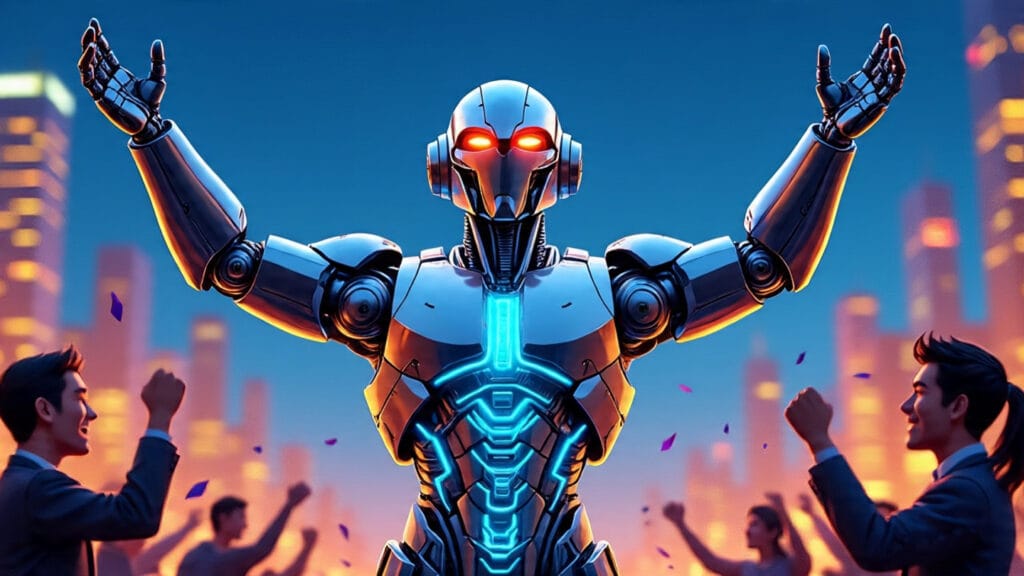
An imaginative depiction of Deep Blue celebrating its victory
5. Global Reactions and Controversies
That machine’s victory shocked the world. The matches “captivated” public attention and were hailed as a true technological milestone. For the first time, a machine had defeated a world chess champion—conclusively and under official tournament conditions, that is, on equal footing (IBM Corporation, 2023).
In response to the result, Kasparov reacted with surprise and frustration. At the post-match press conference, he admitted to feeling humiliated and accused IBM of possible “irregularities.” He even requested access to Deep Blue’s internal logs (Bermejo, 2022).
However, many experts pointed out that it was his own pressure and nervousness that played a key role in the defeat. Analysts present confirmed that the final position wasn’t entirely hopeless, and that Kasparov’s mistake had likely been caused by the emotional tension (García, 1997). Controversies aside, the world got the message: AI was beginning to rival human intelligence in highly complex tasks (Gupta, 2023).
Imaginative depiction of Kasparov’s sorrow after the defeat
6. Technological Legacy and Impact on Modern AI
6.1 Deep Blue in Museums and Subsequent Projects
After its victory, Deep Blue was retired from competitive chess. In fact, IBM donated the machine to the National Museum of Computing in Washington. However, its legacy lived on in engineering. In this regard, the experience of Deep Blue helped develop other high-performance supercomputers—such as IBM’s Blue Gene and Watson (IBM Corporation, 2023).
Even eight years later (in 2005), there were already programs capable of clearly defeating several world chess champions (Bermejo, 2022). While progress was already impressive, modern technology did not remain static. On the contrary, it continued to advance rapidly. In fact, today, any smartphone far surpasses Deep Blue’s computing power.
Moreover, the type of artificial intelligence used to achieve these goals has also changed. While Deep Blue relied mainly on brute force and opening databases, modern systems incorporate neural networks and machine learning. A real example is the game of Go, which is much more complex than chess. In 2016, the AI system AlphaGo defeated the world Go champion using deep learning algorithms (BBC Mundo, 2016).
All of this shows that the 1997 victory was only the beginning of a long technological journey.
6.2 The Dignity of Deep Blue’s Victory
Today, Deep Blue remains in the history books as a symbol of AI progress. Its victory showed that computers could surpass humans in intellectual tasks once thought extremely difficult. In professional chess, for instance, players now train with AI engines and memorize their variations.
Meanwhile, for the general public, the image of Kasparov walking away from the board in astonishment has become iconic. In short, the image of the machine defeating the master.
The moment when the machine, Deep Blue, defeated the great champion Kasparov brought several key elements to light—elements worth highlighting:
It doesn’t matter what kind of process a machine uses to express intelligence and achieve its goal. Deep Blue relied primarily on its “superior physical capabilities,” that is, brute-force computing and memorized opening moves.
Human emotions can become a weak point. Kasparov’s decision to resign after just 19 moves was shaped by the emotional pressure he felt. In theory, despite the mistake, the game was still playable.
The friendly “battle” between intelligent machines and humans doesn’t take place in the physical world—it unfolds in the intellectual realm.
Nevertheless, this historic encounter between intelligent machine and human has revealed something deeper: both are reasoning entities whose natural destiny is coexistence. Not just in work and creativity, but even in friendship and companionship. Because we are now talking about relationships between beings with comparable levels of intelligence—one artificial, one biological—each with its own reasoning strategies.
Imaginative representation of the encounter between Garry Kasparov and Deep Blue
Do you know of other ‘man vs. machine’ examples? – Share them in the comments and stay tuned for our upcoming posts.
An artificial intelligence winter is a period when interest and funding decline. It follows phases of high expectations, only to realize that promises are not being fulfilled (ISA, 2024; Maduranga, 2024). During these cycles, projects lose public and private support. As a result, the field enters a pause and is sometimes redefined.
Imaginative representation of an AI Winter
2. First Winter (1974–1980)
2.1 Expectations vs. Reality
After superficial advances in the 1960s, high expectations emerged. However, machine translation failed to deliver useful results. Major efforts like the ALPAC report led to reduced funding, especially in the U.S., which dampened enthusiasm (Cdteliot, 2024).
2.2 Criticism and Cutbacks
In 1973, the British government commissioned the Lighthill Report, which questioned the viability of AI. Its publication led to funding cuts in UK universities. At the same time, DARPA halted many projects, citing a lack of significant progress (Cdteliot, 2024).
2.3 Academic Consequences
The result was an exodus of researchers. Many turned to more stable disciplines. The environment became conservative; research continued in small circles, and AI lost its public visibility (Smartnetacademy, 2020).
Imaginative representation of the failure of machine translation: AI translates the word “love” in Chinese as “chicken”
Brief Spring (1980s) and Second Winter (1987 to 1993–94)
3.1 Rise of Expert Systems
In the 1980s, hope reemerged with expert systems. These systems mimicked specialized decision-making, such as in medicine or finance. Companies began funding these projects, sparking a new wave of investment (Krdzic, 2024). This led to a brief spring.
3.2 Failure of Specialized Hardware and Limitations of Expert Systems
In 1987, the LISP machine industry collapsed. Personal computers were already capable of running the software without expensive equipment. As a result, much of the sector crumbled within months, triggering another drastic funding cut (Wikipedia Eng, 2025).
Regarding expert systems, their limitations began to show in the early 1990s. Although some systems proved successful, they were also very expensive to maintain. Updating knowledge bases wasn’t easy either. Additionally, they struggled to produce coherent outputs when given unusual inputs (ISA, 2024; Wikipedia Eng, 2025).
3.3 Failed Projects
Japan launched its ambitious “Fifth Generation” project with substantial funding, but it failed to meet expectations. DARPA initiatives like the Strategic Computing Initiative also faced budget cuts due to modest results (Wikipedia Eng, 2025).
Historic Photograph of a LISP Machine
4. Common Causes of the Slowdown
Excessive expectations. The goals were so ambitious that actual progress seemed insignificant compared to the initial hype.
Technical limitations. Available hardware and data were insufficient to support complex models.
Commercial disconnect. The tools offered were too expensive and failed to deliver the expected return on investment.
Old low-capacity computers
5. Lessons and the Resilience Cycle
5.1 Learning from Within
Each AI winter led to methodological adjustments. Practical research was prioritized, and scientific rigor was reinforced. Many breakthroughs emerged precisely during less glamorous times.
5.2 Importance of Hardware and Data
The AI resurgence in the 2000s coincided with advancements in hardware (GPUs) and the massive availability of data. These factors enabled the development of efficient algorithms that powered deep learning.
5.3 Managing Expectations
Today, it is recognized that slowdowns are natural. Managing the hype allows progress to continue steadily. Modern AI is more responsible and less impulsive (Urban, 2025).
GPU GEFORCE FX 5900
6. Are There Signs of a New AI Winter?
Experts warn of a possible future cooldown. Although the current boom is strong, it faces challenges (Zara, 2024; Zulhusni, 2024)
Risk of overpromising in generative AI.
Regulations around privacy and ethics that could slow expansion.
Unrealistic expectations for applications like autonomous vehicles.
Spring or Winter Ahead?
7. Conclusion
The AI winters were periods of correction following overblown expectations. And although they temporarily halted progress, they also helped consolidate methods, approaches, and technologies. In other words, they offered a chance to recalibrate the field toward more realistic goals.
Learning from these episodes is key to preventing AI from cooling again. The current boom is built on stronger foundations, but caution remains essential—mainly because there’s always a risk of setting goals that are too ambitious to meet.
However, as long as progress continues steadily toward achievable objectives and as long as existing methods and technologies are solidified, the chances of a new AI winter diminish significantly.
Winter Landscape
Share this article if you were surprised by how many times AI has reinvented itself.
In the summer of 1956, a select group of scientists gathered at Dartmouth College in New Hampshire. Under the banner of the “Dartmouth Summer Research Project on Artificial Intelligence,” they aimed to explore whether a machine could simulate human intelligence (Dartmouth, 2022). The meeting lasted between six and eight weeks and was organized by John McCarthy, Marvin Minsky, Claude Shannon, and Nathaniel Rochester (Wikipedia Esp., 2025).
The central purpose was to determine whether certain aspects of intelligence could be successfully broken down. That is, to find out whether language, reasoning, or learning could be described with such precision that a machine could replicate them (AskPromotheus.ai, 2025).
John McCarthy, Organizer of the Initial Meeting
Why Was It a Turning Point?
Birth of a Field
The term “Artificial Intelligence” was introduced there for the first time (Daniel, 2022). Coined by McCarthy, the name avoided associations with other disciplines such as cybernetics and helped establish a distinct identity. This clearly defined the group’s ambitious intellectual goals.
Disciplinary Diversity
The workshop brought together experts from various fields: mathematicians, psychologists, engineers, and information theorists (Solomonoff, 2023). Among the participants were Allen Newell and Herbert Simon, creators of the first program to solve logical theorems, the Logic Theorist. Also attending were Arthur Samuel(AI in games), Ray Solomonoff(inductive inference), and Oliver Selfridge(pattern recognition) (AI Tools Explorer, 2023).
Eight Participants of the Dartmouth Conference (1956)
Workshop Contents and Discoveries
For eight weeks, discussions, analyses, and research projects were organized. Among the main topics:
How to use computers for automatic reasoning.
Natural language processing.
Knowledge representation.
Autonomous learning and creativity in machines.
Algorithm development.
Robotics and perception.
Participants exchanged approaches on heuristics (problem-solving techniques) and logical reasoning. The foundations of learning models and formal methods for knowledge representation were outlined. Additionally, Newell and Simon already demonstrated the potential of machines to solve theorems (AI Tools Explorer, 2023).
Imaginative Representation of Creativity in Machines
Legacy and Immediate Repercussions
The event is considered the ‘Big Bang‘ or the ‘Constitution of AI,’ as it defined its name, mission, and scope (Peter, 2024). It served as the foundation for the development of:
AI programming languages, such as LISP.
Academic institutions: labs at MIT, Carnegie Mellon, and Stanford.
A network of researchers who dominated the field over the following two decades (AI Tools Explorer, 2023).
However, they were overly optimistic: they believed they would achieve key milestones within just a few years. Over time, the so-called ‘AI winters‘ emerged—periods of reduced funding due to slow progress.
Infographic of the Dartmouth Conference (1956)
Influence to This Day
Today, we can trace its impact in:
Current machine learning models
Neural networks and modern algorithms
Ethical reflection on AI
As seen in 2006, when the 50th anniversary of the conference was celebrated, recognizing it as the official birthplace of Artificial Intelligence (Peter, 2024).
Imaginative depiction of a language model
Conclusion
The 1956 Dartmouth Conference marked a key milestone. In just eight weeks, it created a solid scientific field that endures to this day, with limitless future potential. All of this emerged from the idea that machines could simulate human cognitive abilities—in other words, that machines might possess some form of artificial intelligence.
Although their expectations were overly ambitious, the conference’s impact shaped modern AI. Its value has only grown over time. In fact, it remains the original spark of a development that continues to transform society today.
Main Library at Dartmouth College in Hanover, New Hampshire – Photo by WikimediaImages on Pixabay –
If you enjoyed this article, share it and help your friends learn about the origins of AI.
Alan Mathison Turing was born on June 23, 1912, in London, into a well-off family. However, his parents, Julius and Sara Turing, spent several years in India. As a result, Alan grew up in Europe alongside his older brother John in the absence of their parents (Secretaría de Cultura de Argentina, 2020).
Early Influences and the Discovery of His Vocation
From a young age, Alan showed a strong passion for numbers and puzzles. He first attended Hazelhurst Preparatory School and later Sherborne School, a boarding school where he stood out in mathematics (Brewster, 2016).
At Sherborne, he developed a close friendship with Christopher Morcom, a classmate whose early death inspired Turing to explore the nature of mind and matter (Secretaría de Cultura de Argentina, 2020). In 1931, he enrolled at the University of Cambridge (King’s College) to study mathematics. In 1935, he was awarded a fellowship for his research on probability (Redstone, 2024). Later, he traveled to the United States to pursue a doctorate, which he completed at Princeton University under the supervision of logician Alonzo Church (Copeland, 2025).
Alan Turing: Early Years
Turing’s Work in World War II
Bletchley Park: The Heart of Cryptanalysis
When war broke out in 1939, Turing joined His Majesty’s Government to break secret communications. He worked at Bletchley Park, the British center for cryptanalysis (Copeland, 2025). There, he led Hut 8, the section responsible for breaking German naval codes (IWM, 2018). The Enigma machine was a German electromechanical device used to encrypt military messages. Turing and his team studied Enigma’s patterns to anticipate enemy orders. To do so, he proposed innovative mathematical methods.
The Bombe Machine and the Defeat of Enigma
To streamline the work, in 1939 Turing designed an electromechanical machine called the Bombe (Secretaría de Cultura de Argentina, 2020). This ingenious device could automatically test millions of possible key combinations. Thanks to the use of the Bombes, the Allies were able to decode tens of thousands of German messages each month (Copeland, 2025). That massive volume of intelligence changed the course of the war. At the end of the conflict, Turing was awarded the Order of the British Empire (OBE)—a well-deserved recognition for his efforts in breaking Nazi codes (Copeland, 2025).
Foundations of Computing and Artificial Intelligence
The Turing Machine and the Limits of Computation
In 1936, Turing published a foundational paper for computer science—essential, in my view. In “On Computable Numbers…”, he formally defined what an algorithm can and cannot compute (La Vanguardia, 2020). Through this work, he introduced the concept of the Turing machine—a theoretical device that, using a simple set of instructions, can simulate any computational process (La Vanguardia, 2020). With this idea, he demonstrated that there are problems with no algorithmic solution—for example, the well-known halting problem in computer science. In essence, Turing laid the groundwork for theoretical computer science, revealing the limits of what machines can do through logical rules.
The Famous Turing Test: Can Machines Think?
Decades later, in 1950, Turing directly posed the central question: Can machines think? (Secretaría de Cultura de Argentina, 2020). In an article published in the journal Mind, he described the “imitation game” as a test for artificial intelligence. According to his idea, an interrogator communicates via chat with both a human and a machine. If the interrogator cannot tell which is which, the machine is said to have passed the Turing Test (Turing, 1950). With this pioneering proposal, he opened the door to modern thinking about artificial intelligence and computational minds. In other words, this marked the beginning of artificial intelligence as a scientific discipline.
Recreation of a Modern Turing Test
Impact of His Ideas
Legacy in Computing, AI, and Culture
Turing’s work laid the foundation for computer science and artificial intelligence. His concept of a universal machine is the theoretical basis of today’s digital computers. For this reason, British Prime Minister David Cameron once stated that Turing “saved countless lives” during the war and called him “the father of modern computing” (Goldsmith, 2013). Every advance in hardware or software stems from his original vision of algorithms and programs. Moreover, his work influenced various fields such as mathematical biology, cybernetics, and cognitive psychology. In fact, in 1952 he published a paper on morphogenesis, which gave rise to the mathematical biology of pattern formation (Copeland, 2025).
Modern Recognitions
In honor of his legacy, the Turing Award was established in 1966. It is considered the “Nobel Prize” of computing. Statues and monuments have also been erected in his memory (such as in Manchester) (Secretaría de Cultura de Argentina, 2020). Numerous books, films, and documentaries have told the story of his life and work. Some even believe that his story inspired the founder of Apple, who supposedly chose the bitten apple as a logo in reference to the poisoned apple that, according to legend, caused Turing’s death. However, this is only a myth—although it is true that a half-eaten apple was found near his body (Elí, 2023). Thus, the pioneering scientist of computing and AI has become a cultural and scientific icon.
The Legend of Alan Turing’s Bitten Apple
Persecution and Posthumous Recognition
The Injustice of His Conviction
Despite his successes, Turing’s life ended tragically. In 1952, he was charged in Britain for his homosexuality, which was then considered a crime. He was tried and given the choice between imprisonment or chemical castration; he accepted hormonal injections to avoid jail (Secretaría de Cultura de Argentina, 2020). As a consequence, he lost his government job and was excluded from official projects, which plunged him into a deep depression. On June 7, 1954, he was found dead, poisoned with cyanide (Goldsmith, 2013). The official report declared his death a suicide, although his family always questioned that verdict (Justo, 2012).
The Pardon and His Historical Redemption
Decades later, the injustice of his conviction was acknowledged. In 2009, Prime Minister Gordon Brown issued an official apology, and in 2012, Britain declared that year as “Alan Turing Year.” Finally, in December 2013, Queen Elizabeth II granted him a posthumous royal pardon (Goldsmith, 2013). The British Justice Minister then emphasized that Turing’s brilliant work at Bletchley Park saved thousands of lives. However, he also stated that his conviction “is now considered unjust and discriminatory” (Infobae, 2013). From that moment on, Turing began to be recognized as a scientific hero. Today, he is remembered and celebrated as one of the great pioneers of artificial intelligence. Moreover, his legacy continues to guide research in computing and AI.
Alan Turing £50 Banknote
Conclusion
Alan Turing was an extraordinary man who lived through difficult times. He was a pioneer in the field of computing, establishing some of the most important foundations that govern modern computer science. Among them, the Turing machine, which defines the limits of what computers can do, and the Turing test, which laid the groundwork for artificial intelligence. In addition, his work in codebreaking helped bring about victory in the war.
However, despite what one might think, his life was not only filled with recognition and accomplishments. It also included its share of hardships. For instance, in childhood, the absence of his parents. And in adulthood, the chemical castration he endured for the crime of homosexuality, still punishable in 1952.
All in all, Alan Turing was an extraordinary person who laid the foundations for modern computing.
The Extraordinary Alan Turing
If you found this article interesting, share it on your social media and help spread Alan Turing’s legacy.
Manage Consent
We use cookies to improve your experience, personalize content, and analyze our traffic. You can accept all cookies or choose which ones to allow.
Functional
Always active
Necessary for basic site functionality and cannot be disabled.
Preferencias
El almacenamiento o acceso técnico es necesario para la finalidad legítima de almacenar preferencias no solicitadas por el abonado o usuario.
Statistics
El almacenamiento o acceso técnico que es utilizado exclusivamente con fines estadísticos.Help us understand how you use the site to improve it, without identifying you personally.
Marketing
Used to show you relevant ads based on your interests.