

- 1. The milestone that changed the relationship between humans and machines
- 2. Origins of Deep Blue and the First Chess Programs
- 3. The First Match Against Kasparov in 1996
- 4. The 1997 Rematch and the Historic Victory
- 5. Global Reactions and Controversies
- 6. Technological Legacy and Impact on Modern AI
- 7. Conclusion
- References
1. The milestone that changed the relationship between humans and machines
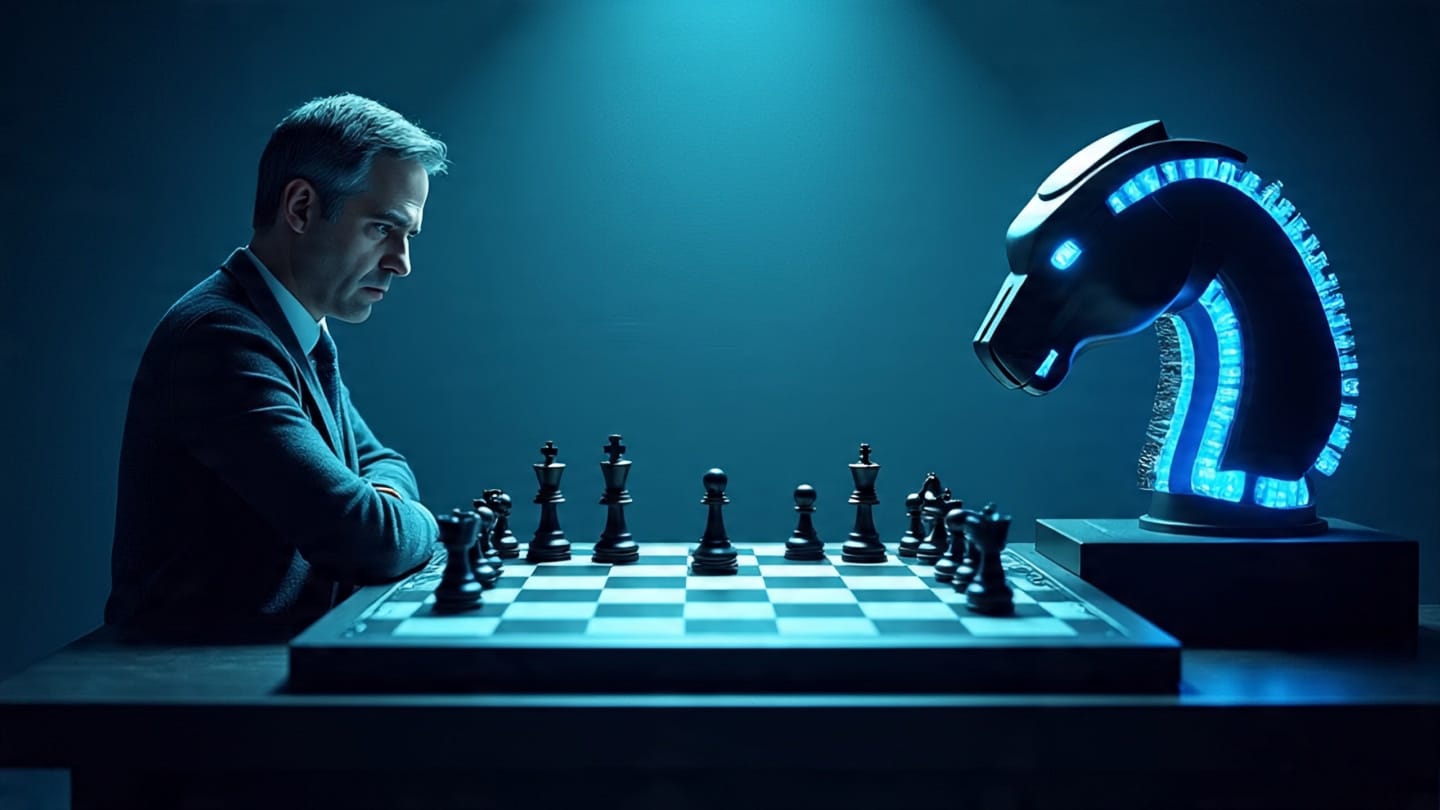
Artificial intelligence has revolutionized the way we see the world. In fact, machine intelligence initially seemed like something out of science fiction. However, a key milestone occurred when an IBM supercomputer defeated the world chess champion—when Deep Blue beat Garry Kasparov (Bermejo, 2022).
It’s worth noting that this victory marked the first time a machine defeated a grandmaster under official conditions (IBM Corporation, 2023).
So, let’s take a look back at this legendary episode—from its origins to its impact on the evolution of AI.

2. Origins of Deep Blue and the First Chess Programs
The story of Deep Blue began decades before the famous 1997 match. Chess had long been considered an ideal test for measuring machine “intelligence.” Moreover, in 1956, the Dartmouth Conference took place, where scientists like John McCarthy and Marvin Minsky formally established the field of artificial intelligence (Wikipedia Esp., 2025).
However, it wasn’t until the 1980s that the idea of chess-playing machines gained real momentum. For instance, the ChipTest program, launched in 1985 at Carnegie Mellon University, competed in two major computer chess tournaments: ACM 1986 and ACM 1987, winning the latter with a perfect score (CPW, 2020).
Shortly afterward, Deep Thought was developed (Wikipedia Eng., 2024). In 1989, Kasparov—already the world champion—defeated it with ease. That humbling loss pushed IBM to acquire the project and build an even more powerful machine. Thus was born the famous Deep Blue (Bermejo, 2022).

– Photo por PIRO4D en Pixabay –
3. The First Match Against Kasparov in 1996
The first official match against Kasparov took place on February 10, 1996, in Philadelphia (Blum, 2010). That day, Deep Blue arrived at the board equipped with cutting-edge technology. In fact, it was capable of calculating around one hundred million positions per second (Bermejo, 2022).
In the first game, the supercomputer won. This made it the first machine to defeat a reigning world champion under standard time controls (Schulz, 2021). The event was historic. However, Kasparov quickly recovered. After that initial scare, he went on to win three games and draw two. He secured the match with a final score of 4–2 (Fernández Candial, 2021).
Although Deep Blue lost that encounter, it had already proven its potential. More importantly, it had made history by beating the champion in a classical game (Schulz, 2021).

4. The 1997 Rematch and the Historic Victory
IBM didn’t give up and upgraded Deep Blue for the 1997 rematch in New York. The new machine (sometimes referred to as “Deeper Blue”) had even more memory and computing power.
In the match, Kasparov won the first game, but Deep Blue took the second (IBM Corporation, 2023). The next three games ended in draws. Then came the sixth and final game. In it, Deep Blue sacrificed pieces with precision, placing Kasparov in a critical position (Gupta, 2023). After only 19 moves (just about an hour of play), the Russian champion made a crucial mistake and resigned (García, 1997).
It was the first time in his career that Kasparov had ever abandoned a game (Gupta, 2023). Undoubtedly, a tough day in his professional journey.
Deep Blue, meanwhile, won the match with a final score of 3.5–2.5 (IBM Corporation, 2023). In other words, IBM’s supercomputer had defeated a grandmaster at his own game.
5. Global Reactions and Controversies
That machine’s victory shocked the world. The matches “captivated” public attention and were hailed as a true technological milestone. For the first time, a machine had defeated a world chess champion—conclusively and under official tournament conditions, that is, on equal footing (IBM Corporation, 2023).
In response to the result, Kasparov reacted with surprise and frustration. At the post-match press conference, he admitted to feeling humiliated and accused IBM of possible “irregularities.” He even requested access to Deep Blue’s internal logs (Bermejo, 2022).
However, many experts pointed out that it was his own pressure and nervousness that played a key role in the defeat. Analysts present confirmed that the final position wasn’t entirely hopeless, and that Kasparov’s mistake had likely been caused by the emotional tension (García, 1997). Controversies aside, the world got the message: AI was beginning to rival human intelligence in highly complex tasks (Gupta, 2023).

6. Technological Legacy and Impact on Modern AI
6.1 Deep Blue in Museums and Subsequent Projects
After its victory, Deep Blue was retired from competitive chess. In fact, IBM donated the machine to the National Museum of Computing in Washington. However, its legacy lived on in engineering. In this regard, the experience of Deep Blue helped develop other high-performance supercomputers—such as IBM’s Blue Gene and Watson (IBM Corporation, 2023).
Even eight years later (in 2005), there were already programs capable of clearly defeating several world chess champions (Bermejo, 2022). While progress was already impressive, modern technology did not remain static. On the contrary, it continued to advance rapidly. In fact, today, any smartphone far surpasses Deep Blue’s computing power.
Moreover, the type of artificial intelligence used to achieve these goals has also changed. While Deep Blue relied mainly on brute force and opening databases, modern systems incorporate neural networks and machine learning. A real example is the game of Go, which is much more complex than chess. In 2016, the AI system AlphaGo defeated the world Go champion using deep learning algorithms (BBC Mundo, 2016).
All of this shows that the 1997 victory was only the beginning of a long technological journey.
6.2 The Dignity of Deep Blue’s Victory
Today, Deep Blue remains in the history books as a symbol of AI progress. Its victory showed that computers could surpass humans in intellectual tasks once thought extremely difficult. In professional chess, for instance, players now train with AI engines and memorize their variations.
Meanwhile, for the general public, the image of Kasparov walking away from the board in astonishment has become iconic. In short, the image of the machine defeating the master.

– By James the photographer under license CC BY 2.0 –
7. Conclusion
The moment when the machine, Deep Blue, defeated the great champion Kasparov brought several key elements to light—elements worth highlighting:
- It doesn’t matter what kind of process a machine uses to express intelligence and achieve its goal. Deep Blue relied primarily on its “superior physical capabilities,” that is, brute-force computing and memorized opening moves.
- Human emotions can become a weak point. Kasparov’s decision to resign after just 19 moves was shaped by the emotional pressure he felt. In theory, despite the mistake, the game was still playable.
- The friendly “battle” between intelligent machines and humans doesn’t take place in the physical world—it unfolds in the intellectual realm.
Nevertheless, this historic encounter between intelligent machine and human has revealed something deeper: both are reasoning entities whose natural destiny is coexistence. Not just in work and creativity, but even in friendship and companionship. Because we are now talking about relationships between beings with comparable levels of intelligence—one artificial, one biological—each with its own reasoning strategies.

Do you know of other ‘man vs. machine’ examples? – Share them in the comments and stay tuned for our upcoming posts.